Meditation
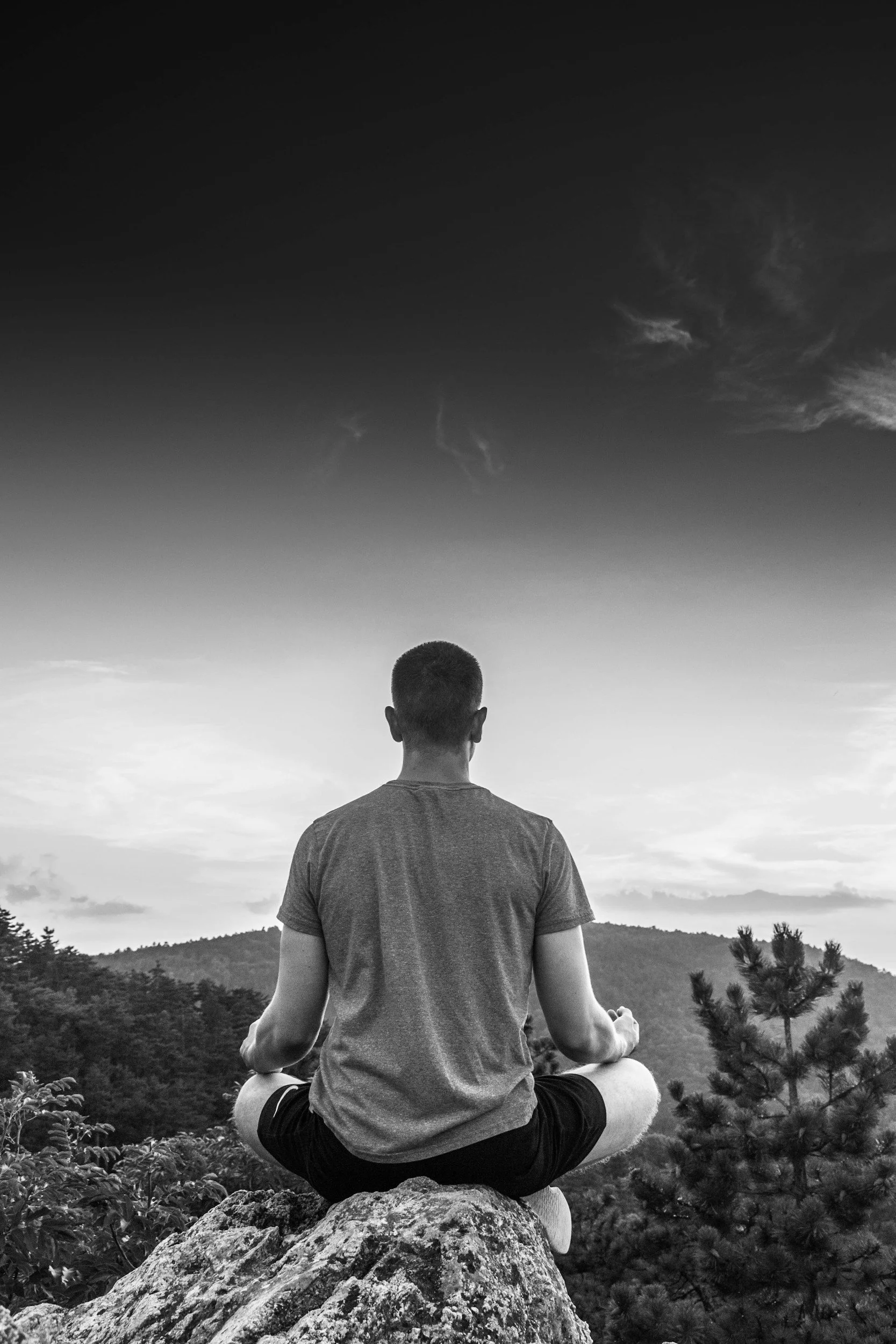
Individual or small group · ongoing
Direct contemplative practice centered on sustained contact with present-moment experience, revealing the mechanics of perception, identification, and reactivity as they unfold.
Suited to those new to meditation and those with an existing practice who want a more grounded, relational approach to presence.
“The present moment is the only moment available to us, and it is the door to all moments.”
— Thich Nhat Hanh
Origins
The meditation offered here draws from the non-dual contemplative traditions, particularly those of Kashmir Shaivism, Tibetan Buddhism, and related lineages, in which meditation is understood not as a technique for inducing calm or achieving particular states, but as a direct means of recognizing the nature of experience itself.
Within these traditions, the ordinary mind, perpetually moved by thought, reaction, anticipation, and commentary, is understood to obscure a clarity and awareness that is always already present; meditation is not the cultivation of something new, but the gradual removal of what covers what is already there.
Historically these practices were transmitted within close teacher-student relationships, where the precision of instruction and the quality of the relationship were considered as important as the practice itself.
What is offered here reflects that understanding: meditation as a living transmission, oriented toward direct experience rather than conceptual understanding, and supported through genuine contact between practitioner and student.
No specific belief system is required. The practice is entered through attention itself, which is available to anyone willing to look.
What this work may support
Meditation may support steadier attention, greater perceptual clarity, and a less reactive relationship with experience.
Over time, the practice can foster discernment, simplicity, and the capacity to remain present without habitually moving toward inner commentary, anticipation, or mental narration. Presence is not treated as a goal to be achieved, but as a quality that gradually emerges through practice.
Effects are not standardized and develop in relation to the individual and the continuity of practice.
The Practice
Sessions emphasize posture, breath, and the quality of listening, allowing attention to settle without excessive effort.
Guidance is offered with precision and restraint, leaving space for silence as a central element of the process. The orientation is experiential rather than conceptual, supporting presence through direct contact with the present moment.
How sessions are held
Sessions may be offered one-on-one or in small groups, in person or online depending on context.
The setting is kept simple and contained, supporting continuity of attention without unnecessary stimulation.
Meditation deepens through regular practice.
A series of sessions allows attention to stabilize and supports a gradual familiarity with the unfolding of experience.
Considerations
This practice may be suitable if you are interested in a simple and direct approach to meditation.
It may not be appropriate if you are seeking guided visualization, emotionally cathartic experiences, or a highly structured method. This practice does not replace medical care or psychological support.
Practical details
Sessions are offered individually or in small groups. In person or online, depending on availability.
Your Questions, Answered
-
Sessions begin with attention to posture and breath: the physical foundation from which the practice unfolds.
From there, guidance is offered with precision and restraint, leaving space for silence as a central element rather than filling the session with instruction.
The orientation is experiential: you are not being told about meditation, you are being supported in doing it; this means that some sessions will feel very still, and others will feel full of movement, thought, or difficulty, both are part of the practice.
What is being developed is the capacity to remain present with whatever arises, rather than succeeding at producing a particular experience.
Over time, sessions shift from guided practice toward shared sitting, less instruction, more accompaniment, with the practice increasingly self-sustaining.
-
The Kuṇḍalinī Hatha Yoga offered here is rooted in the classical Hatha Yoga tradition and is distinct from the style popularised in the West by Yogi Bhajan, which developed as a separate teaching in the twentieth century.
What is offered here draws from a much older framework, one in which Kuṇḍalinī refers not to a technique to be activated through specific kriyas, but to the inherent intelligence of the body-mind system, gradually revealed through sustained practice.
There are no specific garments, rituals, or mantras required. The practice is quiet, embodied, and oriented toward direct experience rather than a particular aesthetic or cultural form.
-
Probably, yes. Most yoga and meditation as it is commonly offered is oriented toward achieving a particular state: relaxation, focus, flexibility, calm.
What is offered here is oriented toward something different: developing a direct relationship with your own experience, whatever it is. This is less about doing it right and more about learning to stay. If previous attempts felt like performance or produced a sense of failing at something, this approach tends to feel quite different.
-
Not necessarily, at least not in the way most people expect. This practice does not aim to suppress, quieten, or resolve anxiety directly, what it supports is a different relationship to anxiety: the capacity to observe it arriving rather than finding yourself already inside it, to be with difficult states without immediately needing them to stop.
Many people find that over time anxiety becomes less of a governing force, not because the practice has eliminated it, but because the relationship to it has changed. The thoughts are still sometimes there; the charge they carry tends to lessen.
This is a different and more lasting shift than the temporary relief that relaxation techniques can provide.
-
No. The practices are rooted in traditional lineages (Hatha Yoga and contemplative meditation traditions) but they are offered here as practical disciplines, not as religious instruction. No belief system is required or assumed. What is required is a willingness to pay attention.
-
In the early stages, weekly sessions tend to build momentum most effectively, enough continuity to establish the practice before it becomes self-sustaining.
Over time, as the practice develops, sessions may move to fortnightly or monthly; there is no fixed requirement, what matters more than frequency is consistency.
A regular practice, even a simple one, develops more depth over time than intensive periods followed by long gaps.
-
Sessions range from 60 to 90 minutes depending on what is being worked with and where you are in the practice. The duration is discussed when you book and may evolve over time as the practice deepens.
-
There is no fixed number, practice develops through continuity: the work is cumulative in a different way from the bodywork cycles, less about reaching a particular point and more about building a relationship with your own experience over time.
Some people begin with a series of weekly sessions to establish the foundation, then move to fortnightly or monthly as the practice becomes more self-sustaining. The aim is not to need the sessions indefinitely, but to arrive at a practice that belongs to you.
-
-
An initial meeting is the natural starting point: to understand where you are, what you are looking for, and whether yoga, meditation or a combination of both makes most sense. From there, a first series of sessions establishes the foundation. You can book an initial meeting directly, or reach out with questions first.
-
Comfortable, loose clothing that allows you to move and breathe freely. For yoga, avoid anything restrictive around the waist or hips. For meditation, warmth matters, the body temperature can drop during stillness, so a light layer to hand is useful.
-
This work may be relevant if you sense that your relationship with your own mind is costing you more than it should, that thought, anxiety, or inner noise has become a kind of background condition you function around rather than something you can actually be with.
It may also be relevant if you have tried meditation before and found that apps, classes, or self-directed practice didn't produce what you were looking for, not because you were doing it wrong, but because something about the context or the approach wasn't quite right.
What is needed is not prior knowledge or a particular state of mind, it is a willingness to sit with experience as it actually is, including the restlessness, the doubt, and the difficulty, without immediately trying to change it; that willingness is something anyone can bring.
"I spent years not quite being present where I was. The practice showed me there was another option."
- L., 51 · Online · Meditation